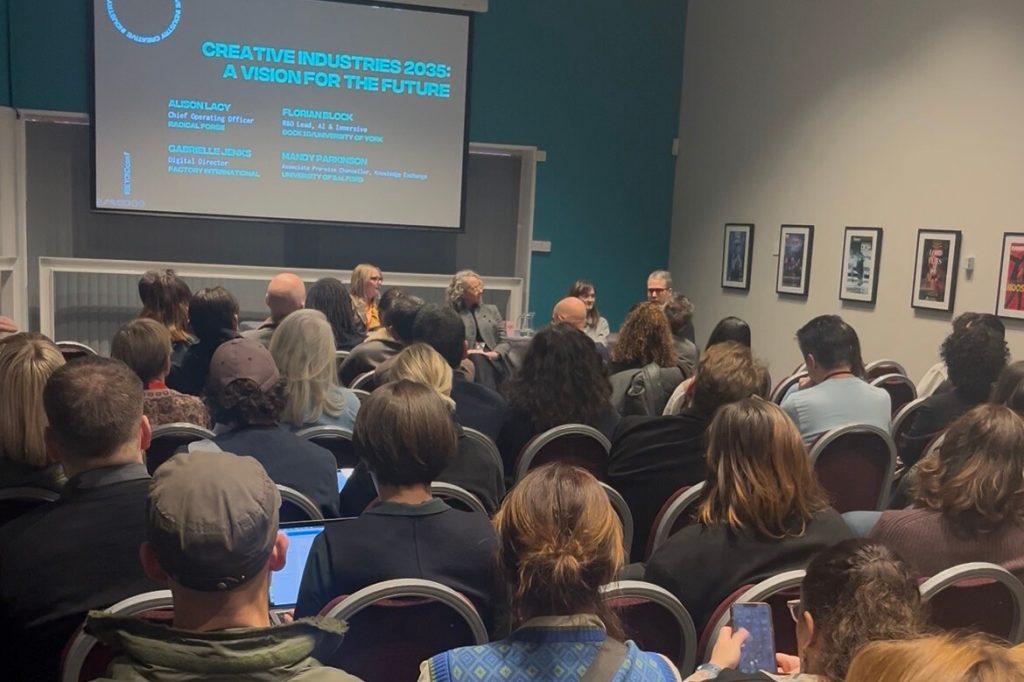
The future of the creative economy has come under the spotlight at a major Salford conference.
Creative companies from far and wide gathered at MediaCity for the Beyond conference to discuss innovation and developments in the sector.
Generative AI and the global challenge to UK culture through gaming and other creative industries were major topics for the delegates.
Mark Leaver, specialist advisor to the Department of International Trade, said the emerging technologies should be seen as offering precise, practical tools.
“Everybody’s talking about AI… but too big,” he argued. “We’re working on small models that create efficiencies in workflows, in production, in delivery.”
He also pointed to the rapid shift in how and where audiences encounter content.
He said: “You’re seeing a complete change in the places people find content and the way they experience it.”
Mark Leaver’s interview: click here
Audiences of the future won’t be passive. They will expect to participate, shape, interact and co-create even more.
Speakers described an acceleration in user-generated content (UGC), interactive storytelling, and audience agency.
Leaver focussed on designing media that immerses people “without putting them in headsets,” – a direction that imagines digital experiences not as escapist bubbles but as blended parts of daily life.
But big questions remains such as what happens when the majority of youth cultural consumption shifts to global gaming platforms?
Should UK broadcasters, historically guardians of cultural identity, standards, and national storytelling, have a larger stake in the types of content shaping young minds?
Some speakers warned that the UK risks losing cultural ground to games dominated by foreign publishers, especially in genres saturated with violent imagery. The implied question lingered: If the future of culture is interactive, who gets to shape it?
And another key message was that the UK public still doesn’t fully understand the true size or shape of its creator workforce.
Hugh Brown, senior lecturer in Cultural and Creative Studies, said: “The creative economy in the UK is a cornerstone of the economy… but in my view, undervalued. There is an enormous swelling of participation and creation that happens at a level that, at the moment, is not even counted.”
For Brown, the platforms, independent creators and traditional media aren’t competing forces; they are part of the same creative ecology.
He said: “Traditional media is constantly searching for the novel… and all of that exists in the independent publishers. There’s a symbiosis there.”
Yet despite this ecosystem, Brown is clear that ethics, representation and diversity remaim persistent problems
He said: “The mainstream creative industries are still colonial-era dominated by certain voices, certain perspectives.”
But he’s not pessimistic. Instead, he points to the “democratic potential” of new media, the ability for unheard creators to find audiences on their own terms.
He said: “Of course, there are unheard voices – really important things that need to be said and heard… and they’re not getting the traction they deserve. But there’s potential with new technologies.”
To hear more click here


Recent Comments